
On this page
- What does gutter installation include?
- How much does gutter installation cost in Fort Wayne?
- Which gutter types are installed in Fort Wayne?
- Gutter parts and terms
- Why Fort Wayne conditions matter
- Choosing the right size and material
- What a good installation looks like
- What to ask a gutter contractor
- Related services
What does gutter installation include?
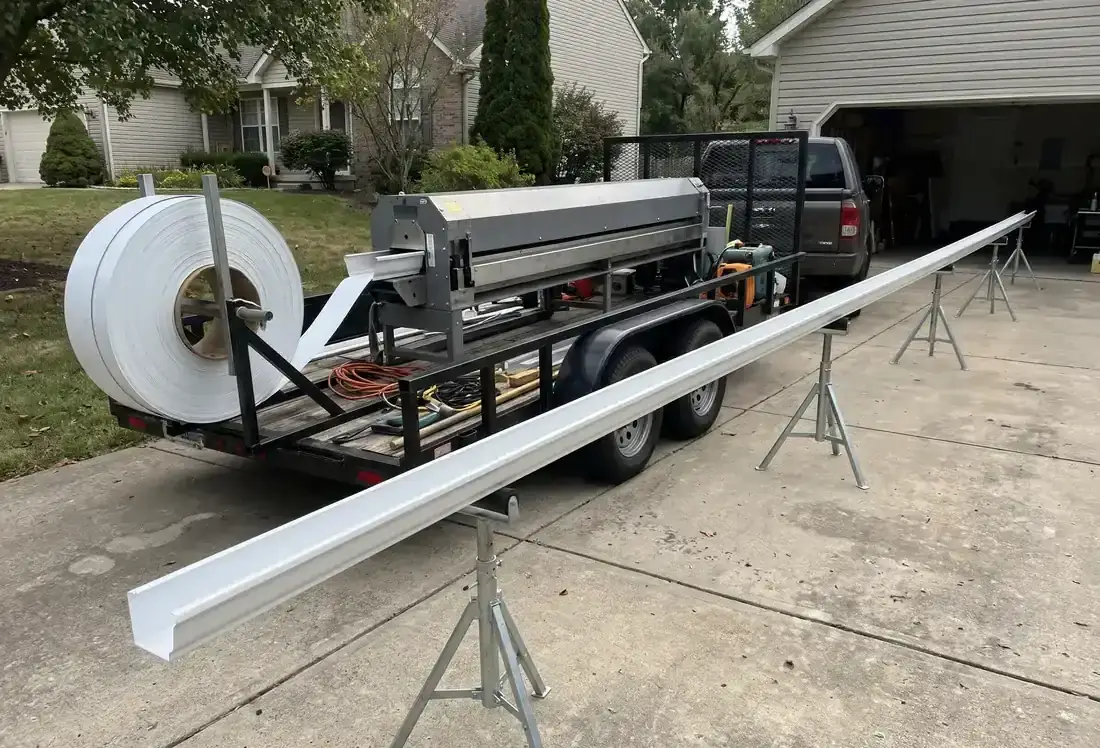
A gutter installation is the whole drainage edge of the roof, not just the trough. A complete job in Fort Wayne normally includes taking down the old gutters, checking the fascia for rot, forming seamless runs to the exact length of each eave, hanging them on hidden hangers with a steady pitch to each outlet, sealing the corners and end caps, and running downspouts and extensions that carry the water away from the foundation.
On older houses the job often starts with the wood. Painted fascia on a 1920s bungalow in Forest Park or a 1950s ranch in Waynedale may have soaked up years of overflow. New gutters screwed into soft wood will pull away the first winter, so the bad sections are replaced first.
How much does gutter installation cost in Fort Wayne?
Gutters are priced by the linear foot. National guides put seamless aluminum at about $9 to $13 a foot installed, steel at about $8 to $13 and copper at about $15 to $40. Going from 5-inch to 6-inch typically adds about 50 cents to $1 a foot. These are national ranges, not local quotes.
What moves the price on a Fort Wayne house:
- Total length. Long ranches and houses with wings and porches simply have more feet of eave.
- Height. Two-storey houses need longer ladders or lifts and take longer to hang.
- Corners and outlets. Every inside or outside miter and every downspout adds labour and parts.
- Removal and wood repair. Taking down old gutters and replacing rotten fascia or soffit.
- Material and profile. Half-round and copper cost more than K-style aluminum.
The Fort Wayne gutter cost guide walks through a worked example.
Which gutter types are installed in Fort Wayne?
| Type | Where it fits | Notes |
|---|---|---|
| Seamless aluminum | Most houses | Formed on site, no seams except at corners; the usual choice |
| 6-inch gutters | Two-storey houses, steep roofs, valleys | Carries more water; pairs with 3x4 downspouts |
| Aluminum in heavier coil | Snow-load areas | Thicker coil resists denting from ice and ladders |
| Half-round | Tudors, Craftsman and Victorian houses | Traditional look, often with round downspouts |
| Copper | Historic homes, stone and brick | Long life; develops a patina |
| Downspouts | Every house | 2x3 or 3x4, with elbows, extensions and splash blocks |
Gutter parts and terms
| Term | What it means |
|---|---|
| K-style | The most common profile, with a flat back and decorative front |
| Hidden hanger | A bracket inside the gutter, screwed through to the fascia |
| Spike and ferrule | Older fastening: a long nail through a tube; works loose over time |
| Outlet or drop | The hole and collar where the downspout attaches |
| Miter | A corner joint, inside or outside |
| End cap | The closed end of a run |
| Drip edge / gutter apron | Metal flashing that leads water off the shingles into the gutter |
| Pitch | The slight fall toward each outlet, often around a quarter inch per 10 feet |
| Coil thickness | The gauge of the aluminum, such as .027 or .032 inch |
Why Fort Wayne conditions matter
Fort Wayne averages about 39.5 inches of precipitation a year, and the National Weather Service counts about 39 thunderstorm days a year, mostly from May to August. Short, intense storms are what test gutter size: a run that copes with steady rain can overflow when a thunderstorm dumps water off a big roof plane.
Winter is the other test. With about 33.6 inches of snow in an average year, gutters carry snow and ice for weeks at a time. Hangers screwed into solid wood at close spacing hold up far better than the spikes and ferrules found on many older houses.
The ground matters too. Fort Wayne is built on flat glacial land, with the Fort Wayne Moraine along the rivers and the old Great Black Swamp plain to the east. Water does not drain away quickly, so where the downspouts discharge is as important as the gutters themselves. About a third of the city has combined sewers, and City Utilities encourages owners to disconnect or redirect downspouts that run into the ground.
Choosing the right size and material
Start with the roof, not the old gutter. A large two-storey roof in Aboite or Huntertown, especially one with valleys, sheds far more water at the eave than a single-storey ranch. That is where 6-inch gutters and larger downspouts earn their cost. Read 5-inch vs 6-inch gutters for the comparison.
For material, most houses get seamless aluminum. Heavier coil resists dents from ice, falling limbs and ladders. Steel is stronger but rusts when the coating is scratched. Copper and half-round suit older homes in districts such as West Central and Williams-Woodland Park. See aluminum vs steel vs copper and seamless vs sectional.
What a good installation looks like
- Each run is measured and formed in one piece, with seams only at corners.
- Hangers are screwed, not nailed, into solid fascia, close enough together for snow and ice.
- The gutter sits under the drip edge so water cannot run down behind it.
- Pitch is even; water poured at the high end runs out the downspout with nothing left standing.
- Corners are strapped and sealed; end caps are crimped and sealed.
- Downspouts are fastened to the wall and end in extensions or splash blocks that carry water away from the foundation.
- Old gutters, nails and offcuts are cleared from the yard.
What to ask a gutter contractor
- Which gutter size and coil thickness are you quoting, and why that size for my roof?
- How many downspouts, where will they go, and where will each one discharge?
- What hangers will you use and how far apart, given our snow load?
- Will you check and replace soft fascia, and how is that priced?
- Is drip edge or gutter apron included where it is missing?
- Are you licensed with the Allen County Building Department, and can I see proof of insurance?
- What warranty covers the workmanship, and what covers the material?
- Will you haul away the old gutters and clean up the yard?
Related services
- Gutter replacement when existing gutters are worn out
- Gutter guards to fit at the same time
- Gutter repair if only part of the system has failed
- Commercial gutters for shops, churches and apartment buildings