
On this page
- How do screens and reverse-curve guards work?
- How much do screens and reverse-curve guards cost?
- Comparing guard types
- Which Fort Wayne trees suit screens or reverse-curve?
- Heavy rain and reverse-curve guards
- Screens and snow
- When screens are the sensible choice
- When to choose micro-mesh instead
- What to ask about screens and reverse-curve guards
- A worked example
How do screens and reverse-curve guards work?
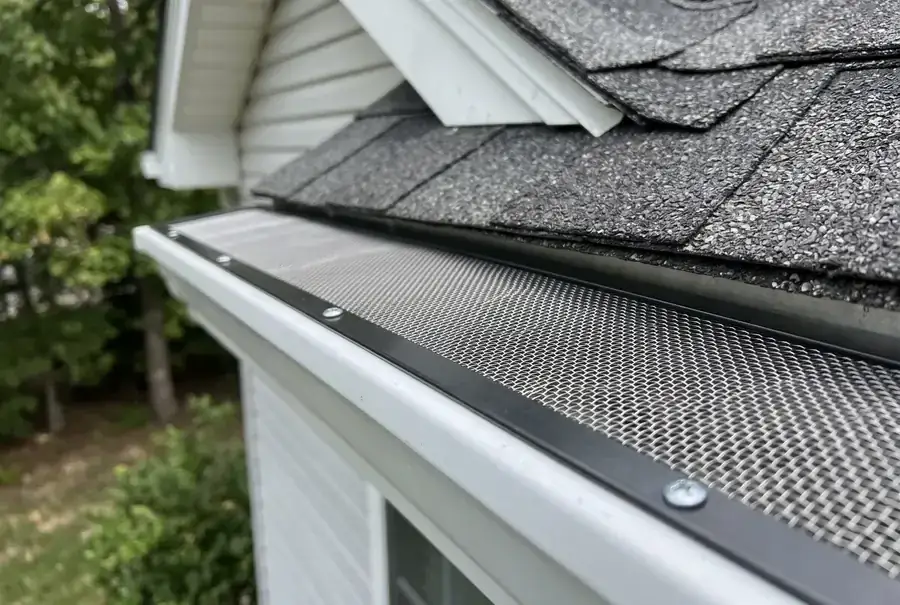
A gutter screen is a perforated sheet of metal or plastic laid over the gutter. Water falls through the holes; large leaves sit on top until wind or rain moves them. A reverse-curve guard is a solid cover whose front edge curves downward. Water clings to the curve and runs into a slot, while leaves slide off the front. Both are simpler than micro-mesh, and screens in particular cost much less.
They work well where the main problem is large leaves and the roof is not too steep. They work less well under trees that drop small seeds and needles, and reverse-curve covers can be overwhelmed in very heavy rain.
How much do screens and reverse-curve guards cost?
National guides put professionally installed gutter guards at about $6 to $13 per linear foot, with an average job around $1,514. Basic screens fall at the low end or below, especially as DIY products. Reverse-curve systems are often priced near micro-mesh. A contractor's quote should list the product, fastening method and any gutter repairs.
Comparing guard types
| Guard | Best at | Weak at | Rough cost level |
|---|---|---|---|
| Plastic screen | Large leaves | Seeds, needles, durability | Low |
| Metal screen | Large leaves, longer life | Seeds, needles | Low to moderate |
| Reverse curve | Large leaves | Heavy rain on steep roofs; seed film on the curve | High |
| Micro-mesh | Seeds, needles, grit and leaves | Needs an occasional brush | High |
Which Fort Wayne trees suit screens or reverse-curve?
- Oaks and big-leaf maples dropping mostly large leaves: screens and reverse-curve both help.
- Silver and red maples with heavy seed drop: seeds slip through many screens; micro-mesh does better.
- Pines and spruce: needles lodge in screen holes; reverse-curve or micro-mesh is better.
- Mixed young trees in newer subdivisions: a basic screen may be enough for years.
Heavy rain and reverse-curve guards
Reverse-curve guards rely on water following the curve. In a hard Fort Wayne thunderstorm, and the city averages about 39 thunderstorm days a year, water off a steep roof can move too fast to follow the curve and shoot past it. On large, steep roofs in Aboite or Huntertown, ask the contractor how the guard performs in heavy rain, and consider 6-inch gutters with mesh instead.
Screens and snow
Fort Wayne averages about 33.6 inches of snow a year. Loose-fitting snap-in screens can be pushed down into the gutter or lifted by snow and ice. Screens should be fastened to the gutter lip and the fascia or roof edge. Guards of any type do not prevent ice dams.
When screens are the sensible choice
- Single-storey houses where the owner can check and clean easily.
- Homes under oaks and large-leaf maples with little seed or needle drop.
- Rentals or budget projects where a basic improvement is enough.
- Newer houses in New Haven, Leo-Cedarville or Roanoke with young trees.
When to choose micro-mesh instead
Under heavy maples, pines or mixed mature trees, as in Forest Park, Indian Village and Southwood Park, micro-mesh guards usually perform better and need less attention.
What to ask about screens and reverse-curve guards
- What exactly will this guard stop, and what will get through?
- How is it fastened, and will snow lift it?
- How does it perform in heavy rain on my roof pitch?
- Does it affect the roof warranty?
- Will you fix the gutters before fitting it?
A worked example
A single-storey house in Roanoke has one big oak near the back gutter and nothing else nearby. The owner cleans the gutters twice a year and only the back run clogs. A metal screen on that run, at the low end of the national installed range, may be all that is needed. Under maples or pines, micro-mesh would be the better buy.